
That Frustrating Moment When Your Garage Door Won't Stay Closed
You press the button on your remote, watch your garage door start its descent, and then — just before it reaches the floor — it reverses direction and goes right back up. You try again. Same thing. Maybe you try holding the wall button down, and it still won't cooperate.
This is one of the most common garage door complaints we hear from homeowners in Oro Valley, and for good reason. A garage door that won't close all the way is more than an annoyance. It's a security risk, an energy waste, and an open invitation for dust, critters, and Arizona's extreme heat to enter your garage.
The good news is that this problem usually has a straightforward explanation. Let's walk through the most common reasons your garage door reverses before hitting the floor and what you can do about each one.
1. Misaligned or Dirty Safety Sensors
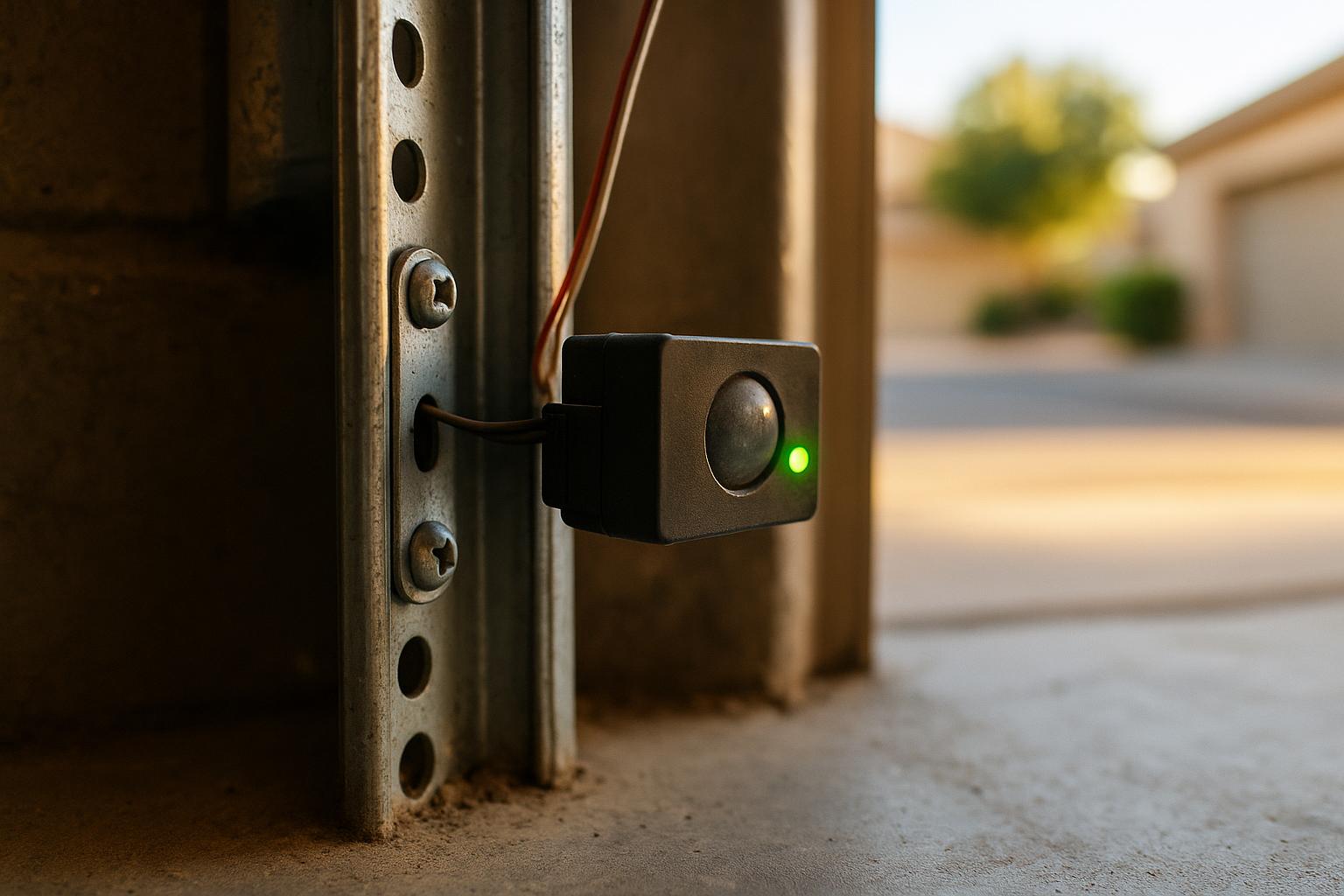
This is the number one cause of a garage door that reverses before closing. Every garage door opener manufactured after 1993 is required to have photo-eye safety sensors mounted near the bottom of the door tracks, about six inches off the ground. These sensors send an invisible beam across the opening. If something breaks that beam — a child, a pet, a trash can — the door automatically reverses to prevent injury.
The problem is that these sensors can become misaligned from a bump, vibration, or even settling of your garage structure over time. They can also get coated with dust and cobwebs, which is especially common here in the Tucson area where fine desert dust is a constant companion.
What You Can Do
- Check the LED lights on both sensors. Typically, one glows green and the other amber. If either light is blinking or off, the sensors aren't communicating properly.
- Wipe the lenses gently with a soft cloth to remove dust, dirt, or spider webs.
- Check alignment by ensuring both sensors are pointing directly at each other. You can loosen the mounting bracket, adjust the angle, and retighten.
- Look for obstructions — even a small leaf or piece of debris in the sensor's path can trigger a reversal.
2. Incorrect Close-Limit Settings
Your garage door opener has limit settings that tell it exactly how far the door should travel when opening and closing. If the close-limit setting is off, the opener may think the door has hit an obstruction when it's actually just reaching the floor. The opener's built-in safety feature then kicks in and reverses the door.
This issue often appears after a new opener installation, a power outage, or when the opener's settings have been accidentally changed.
What You Can Do
Most openers have adjustment screws or a digital control panel that lets you fine-tune the travel distance. Your owner's manual will have specific instructions for your model. The adjustment is usually small — a quarter turn at a time — so make incremental changes and test after each one. If you're not comfortable making this adjustment yourself, a garage door technician can dial it in quickly.
3. Worn or Damaged Rollers and Tracks
When rollers become worn, cracked, or caked with grime, they create resistance as the door moves along the tracks. The same goes for tracks that are bent, dented, or misaligned. Your opener interprets this extra resistance as an obstruction and reverses the door as a safety precaution.
In Oro Valley, where temperatures can swing dramatically between scorching summer days and cool desert nights, metal tracks and hardware expand and contract regularly. Over time, this thermal cycling can contribute to track misalignment and roller wear.
What You Can Do
- Visually inspect the tracks for dents, bends, or gaps where the track sections meet.
- Look at the rollers — if they're cracked, chipped, or no longer rolling smoothly, they likely need replacement.
- Clean the tracks with a damp cloth to remove built-up dirt and debris. Avoid using WD-40 or grease on the tracks themselves, as this can attract more grime.
4. Broken or Weakening Springs
Your garage door springs do the heavy lifting — literally. They counterbalance the weight of the door so the opener doesn't have to work as hard. When springs weaken or break, the door becomes significantly heavier for the opener to move. The opener may struggle on the way down and trigger a reversal because it detects excessive force.
If you notice your door seems sluggish, makes loud straining noises, or if you can see a visible gap in one of the torsion springs above the door, you likely have a spring problem.
What You Can Do
Do not attempt to repair or replace garage door springs yourself. These components are under extreme tension and can cause serious injury if handled improperly. This is a job for a trained professional. If you suspect a spring issue, call a qualified garage door repair company to inspect and replace them safely.
5. The Opener's Force Settings Need Adjustment
In addition to limit settings, most garage door openers have force settings that control how much power the motor uses to open and close the door. If the downward force is set too low, the opener won't push hard enough to close the door completely, and it will reverse as though it's encountered resistance.
What You Can Do
Similar to limit adjustments, force settings can usually be adjusted with a screwdriver or through a digital interface on the opener unit. Again, make small adjustments and test repeatedly. Be careful not to set the force too high, as this can override the safety reversal feature and create a hazard.
6. Wiring Issues or Opener Malfunction
If you've checked everything above and the door still reverses, there may be a wiring issue between the sensors and the opener, or the opener's logic board could be failing. Frayed wires, loose connections, and electrical shorts can send false signals that mimic an obstruction. Circuit boards can also degrade over time, especially in garages that aren't climate-controlled and endure the intense Oro Valley summer heat.
Diagnosing electrical issues requires some expertise and a multimeter. If you suspect a wiring or circuit board problem, it's best to have a professional take a look.
When to Call a Professional
Some of these fixes — cleaning sensors, checking for obstructions, wiping down tracks — are perfectly safe for any homeowner to handle. But when the problem involves springs, electrical components, or adjustments you're not confident making, calling a professional is the smart move.
At Oro Valley Garage Door Co, we troubleshoot reversing doors regularly. In most cases, we can diagnose and resolve the issue in a single visit. We serve homeowners throughout Oro Valley, Marana, Catalina Foothills, and the greater Tucson area, and we're available for emergency service when your garage door simply won't cooperate.
Don't Ignore a Reversing Garage Door
A garage door that won't close is a problem that tends to get worse, not better. What starts as an occasional reversal can become a door that refuses to close at all. More importantly, a malfunctioning safety system could fail to protect your family when it matters most.
If your garage door is giving you trouble, take a few minutes to check the sensors and tracks. If that doesn't solve it, give us a call. We'll get your door closing properly so you can get back to your day without the frustration.